
MSc Intenship on biofouling research


Biofouling in shipping refers to the accumulation of marine organisms such as algae, barnacles, and mollusks on a ship’s hull and underwater structures. This biological growth increases the local surface roughness, leading to higher hydrodynamic drag, which in turn raises fuel consumption and greenhouse gas emissions. Biofouling also accelerates corrosion and maintenance costs, reduces vessel speed and efficiency, and facilitates the spread of invasive species across regions, posing significant ecological and economic challenges to the maritime industry.
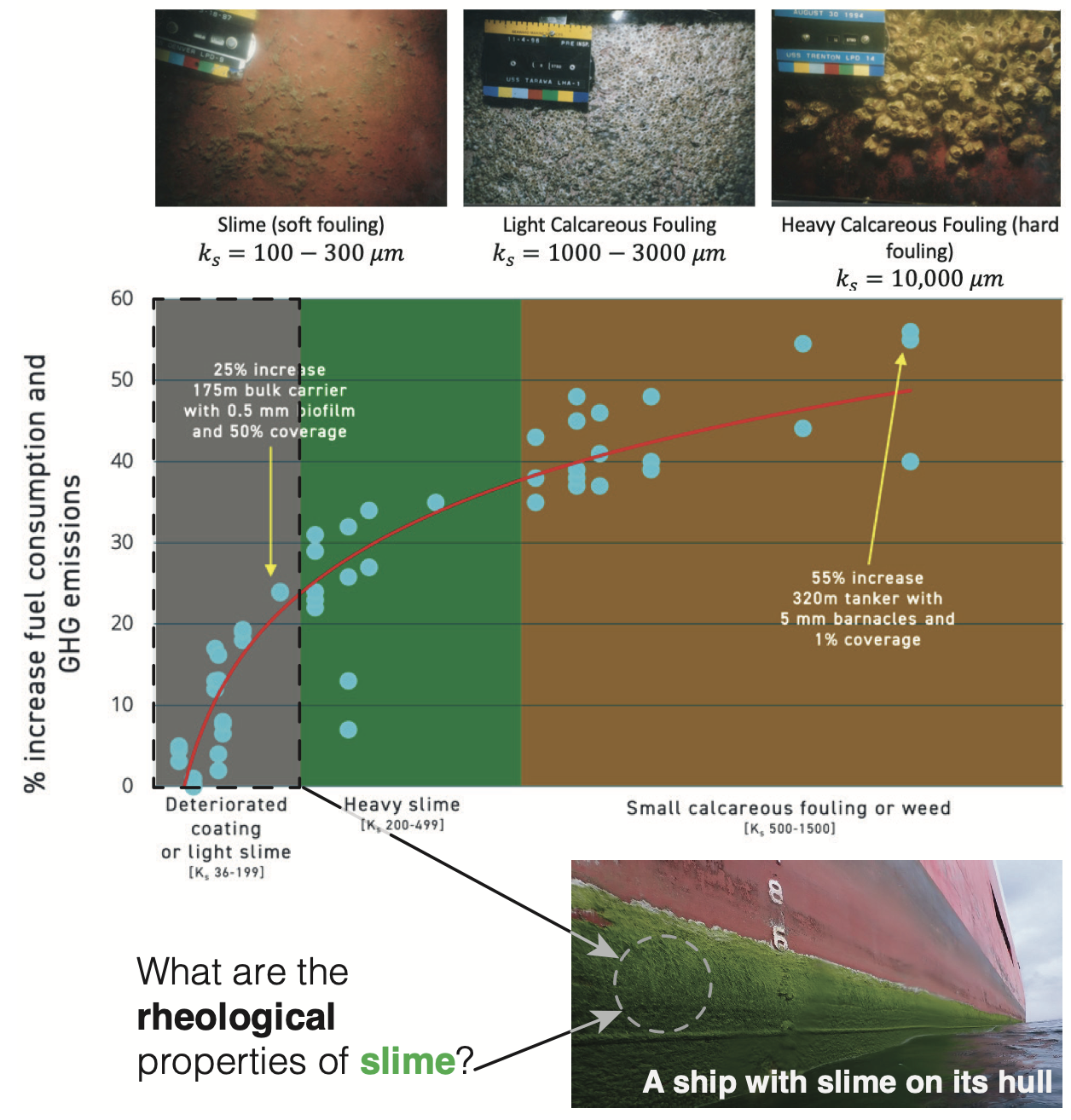
In the context of biophysics and engineering applications, biofouling is traditionally categorized by looking at a corresponding equivalent sand grain roughness . Biofouling with high-values of (~) corresponds to heavy calcareous fouling – the so-called “hard fouling”. Similarly, the so-called “light fouling” is attributed to and finally, the so-called “soft fouling” – which consists of slime layers – is characterized by . The common understanding is that as grows, the effect of roughness will be larger and so will be the drag which in turn will lead to an increase in added ship resistance. Strikingly, recent studies have pointed out that that already slime layers – which have a low – can cause approximately 20% of increase in fuel consumption and GHG emissions. Notably, the knowledge of these kinds of biofilms and their influence is scarce which calls for additional research efforts.
THE ASSIGNEMENT
MARIN is an international, independent, hydrodynamics research institute based in Wageningen that operates in the maritime sector. Currently, MARIN is investigating how to improve their existing experimental, numerical and data-driven tools to better predict the influence of biofouling on ships which could lead to better and more efficient cleaning strategies as well as the reduction of greenhouse emissions. As a part of these research activities, MARIN aims to better understand the role of slime and biofilms in added ship resistance. A key component behind this is to investigate the morphological, mechanical – and more importantly – the rheological properties of slime.
For this MSc assignment (~9-12 months), we are looking for a motivated candidate who will perform rheological measurements on both artificial and real slime from a ship and characterize these properties as a function of relevant parameters such as the shear stress, temperature and for different ships. The latter is also of interest as ships sail at different speeds and are exposed to different environmental conditions such as salinity, water temperature, light intensity and nutrient density – all which affect the growth of biofilms on ship hulls. The work is both experimental and theoretical and it involves on-site work and travelling within the Netherlands to collect specimens and transport them to the laboratories at the University of Amsterdam (UvA). In addition to the experiments, the candidate will perform a literature review on biofilms and viscoelasticity in order to compare experimental data with existing models and/or develop new ones. One of the main objectives of the project is to find a suitable material (artificial fouling) that best represents the properties of real slime which would be a monumental contribution to the field.
This MSc assignment is a joint collaboration between MARIN and the FluidLab led by Prof. dr. Mazi Jalaal at UvA. As such, the student will make use of the state-of-the-art experimental facilities at both UvA and MARIN and will collaborate closely with both academic and industrial partners.
The student will receive a monthly stipend of 700 EUR from MARIN.
CONTACT INFORMATIONInterested in this project? Please contact Mazi Jalaal (m.jalaal@uva.nl) or Rodrigo Ezeta (r.ezeta@marin.nl) for more information.